

















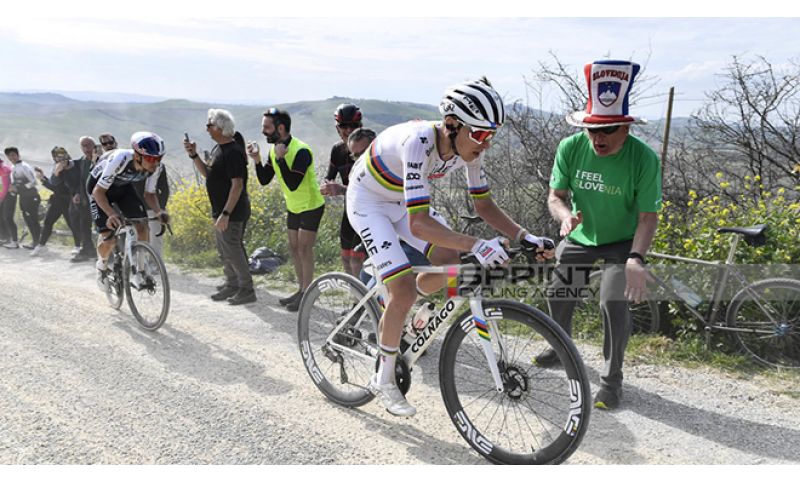
Thanks to a careful analysis conducted by Velon, it was possible to understand more about Tadej Pogacar's racing style and why he managed to beat Pidcock at the latest Strade Bianche. It's all about strength and how power is developed during movement.
Looking at the attack Pogacar made at Colle Pinzuto, eighteen kilometers from the finish line, we see how the world champion pushed an average of 630 watts for 1'06", with a peak of 810 watts. The acceleration, according to Velon analysts, was not particularly explosive (an 810-watt peak during an attack is not that high), but pushing 630 watts while sitting on the saddle for a minute after a hard race, that is truly an extraordinary performance.
The analysis focused on highlighting the attack and climbing style of Pogacar and Pidcock: the British rider, like most cyclists, stands up on the pedals to develop more power and stays there for a long time, while Pogacar rarely stands up and when he does, it's for just a few seconds.
The difference between the two champions is evident in the two decisive attacks made by the Slovenian, when 78 kilometers from the finish, Pogacar and Pidcock broke away and the British rider remained on the pedals for 37 seconds, while Pogacar needed just 3. Continuing the analysis, in the attack where Pogacar left Pidcock behind 18 kilometers from the finish, we witnessed a practically identical scene. At the beginning of his attack, Pogacar is standing on the pedals for about a second and a half, but does the rest of the effort while remaining seated on the saddle, while Pidcock was again forced to stand on the pedals for 32 seconds.
What really needs to be emphasized is not so much that Pidcock spends so much time on the pedals, but rather that Pogacar immediately sits down during both of his attacks. Usually, those who attack always do so standing on the pedals, because this way you are more explosive and can use maximum power, but the Slovenian has his own, truly unique style, making him an unrivaled attacker.
After seeing and reviewing those actions, it's right to ask: why does Pogacar almost always attack while sitting? During the last attack at Strade Bianche, perhaps there was the problem of injuries from a fall, which no longer allowed him to stand up correctly on the handlebars, or simply because he no longer had that push in his legs.
Another hypothesis comes from better handling on the finest gravel. It's not to be excluded that the world champion feels more secure attacking on dirt roads while remaining in a seated position.
Among the hypotheses related to position, there is also the one that suggests that since Pogacar changed coaches in November 2023, with Iñigo San Millán being replaced by Javier Sola, the latter wanted to change some positions. Some experts have noted that after changing coaches, the world champion has achieved better results on longer climbs, but consequently has lost some of his explosiveness. The shorter cranks now used by Pogacar (165 mm instead of 172.5 mm) could also be part of the explanation. A shorter crank would guarantee more flexibility, but would also have a negative impact on explosiveness.
Summing up and looking back at what happened on Saturday in Tuscany, the Slovenian has a seated power level significantly higher than everyone else. Pidcock was undoubtedly in excellent form in Siena, but still had great difficulty keeping pace, even while standing on the pedals. Good seated power is an incredible advantage, because a rider cannot remain standing on the pedals for long periods trying to unleash maximum power.
This way of pedaling, according to the experts of the Flemish Classics, is a fundamental element for those who, like him, aim to win races like the Tour of Flanders and Paris-Roubaix. So it's very likely that the show at the upcoming Classics will be even more exciting, because after seeing Pogacar's technique at Strade Bianche, in a few weeks it will be possible to understand if this characteristic of seated pedaling will be more effective than the propulsive attacks of riders like Mathieu van der Poel and Wout van Aert.

 1
1


 1
1


 2
2
3
3
2
2
3
3

 Ritratti
 Oscar
Oscar Albi d'Oro

